
Serious incident notifications are an important part of regulatory oversight across children’s social care. However, deciding whether an incident should be notified to Ofsted is not always as straightforward as identifying that “something serious happened”.
During training, consultancy and compliance work, we regularly see uncertainty around notification decisions. Does police involvement automatically mean that Ofsted must be notified? Should every episode of self-harm be reported? What about a child going missing? Does hospital attendance automatically make an incident serious?
The answer often depends on the regulatory framework applying to the service, the specific notification category and, in some circumstances, the Registered Person’s assessment of seriousness.
Different Services, Different Notification Requirements
One of the difficulties is that children’s homes, supported accommodation services and independent fostering agencies do not operate under exactly the same notification framework.
For children’s homes, Regulation 40 of the Children’s Homes (England) Regulations 2015 identifies events that must be notified, including the death of a child, safeguarding referrals, known or suspected sexual exploitation, allegations of abuse and the instigation or conclusion of a child protection enquiry.
However, Regulation 40 also requires notification where an incident requiring police involvement occurs in relation to a child and the Registered Person considers the incident to be serious. It also includes any other incident relating to a child that the Registered Person considers serious.
Supported accommodation providers operate under Regulation 27 of the Supported Accommodation (England) Regulations 2023. While there are similarities, the notification categories are not identical.
Regulation 27 specifically includes known or suspected sexual exploitation or child criminal exploitation and incidents involving a measure of restraint. As with children’s homes, there are also circumstances where the Registered Person must determine whether an incident should be considered serious.
Independent fostering agencies operate under the notification requirements within the Regulation 36 and Schedule 7 of the Fostering Services (England) Regulations 2011.
The framework includes the death, serious illness or serious accident of a child placed with foster parents, certain safeguarding referrals, reportable infectious diseases within a foster home, known or suspected sexual exploitation, serious incidents requiring police attendance at a foster home, serious complaints against approved foster parents and child protection enquiries.
This means that the same broad type of incident may not have exactly the same notification threshold across different children’s social care settings.
Police Involvement Does Not Always Answer the Question
Police involvement is one of the areas where we see the greatest uncertainty.
Managers sometimes assume that any contact with the police automatically requires an Ofsted notification. Others may take the opposite approach and only notify where an arrest has been made.
Neither approach properly reflects the need to consider the regulatory threshold applying to the service.
The key question is not simply:
Were the police involved?
The Registered Person must also consider:
Does the Registered Person consider the incident to be serious?
Ofsted’s guidance indicates that serious police involvement will usually involve the police taking action in response to an incident, such as making an arrest, taking witness statements or responding directly to an incident.
However, contact with the police alone does not necessarily mean that a separate police involvement notification is required.
The nature of the incident, the police response, the risk to the child or others, the outcome and the wider circumstances all need to be considered.
The position within fostering is different again. The notification framework specifically considers a serious incident involving a child placed with foster parents where the police have been called to the foster parent’s home.
Understanding these distinctions is important when making and recording notification decisions.
What Does “Serious” Actually Mean?
Perhaps the most difficult question is deciding when an incident should be considered serious.
There is no simple scoring system that automatically determines seriousness.
A Registered Person may need to consider the nature of the incident, actual harm, potential harm, the child’s vulnerability, the level of safeguarding risk, the involvement of emergency services and the impact on other children or the service.
Context matters.
An incident that appears relatively minor when viewed in isolation may become significantly more concerning when considered alongside previous incidents.
For example, repeated missing episodes, increasing police involvement, escalating self-harm, changes in peer associations or repeated incidents of violence may indicate a developing pattern of risk.
This is why managers should avoid reviewing every incident entirely in isolation.
The question may not simply be:
Was this individual incident serious?
It may also be:
Does the pattern, frequency, escalation or cumulative impact of these incidents now represent a serious concern?
Self-Harm, Missing Episodes and Hospital Attendance
These are three areas where notification decisions can become particularly difficult.
Ofsted’s current guidance indicates that self-harm resulting in minor injuries will not usually require a serious incident notification solely on that basis. However, serious self-harm, a significant escalation or wider concerns about risk to life may require a different decision.
Similarly, a child going missing does not automatically require a Regulation 40 notification.
Ofsted indicates that notification should be considered where there are serious concerns about unusual behaviour or patterns that indicate increased risk, where the child may be at grave risk because of their age or vulnerability, or where the child has been missing for a considerable period and their whereabouts are unknown.
Hospital attendance can also create confusion.
The fact that a child attended hospital should form part of the assessment, but managers should understand the specific regulatory framework and Ofsted guidance applying to their service. The reason for attendance, treatment received, seriousness of the injury or illness and wider safeguarding context may all be relevant.
The focus should remain on informed regulatory decision-making rather than automatic notification based on a single factor.
The Registered Person’s Evaluation Matters
Ofsted’s serious incident reporting forms do not simply ask providers to describe what happened.
They also require information about the Registered Person’s evaluation of the incident and the actions taken or proposed.
This is an important distinction.
A notification should not simply read as a longer version of the incident report.
The Registered Person should be able to demonstrate that they have considered the event, understood the risks, evaluated the response and identified any action required to reduce the likelihood of recurrence.
Equally, where a decision is made not to notify, providers should consider whether the rationale for that decision has been clearly recorded.
A well-evidenced decision may explain which notification categories were considered, why the event did not meet a mandatory notification category and, where relevant, why the Registered Person did not consider the incident to be serious.
The decision is part of management oversight.
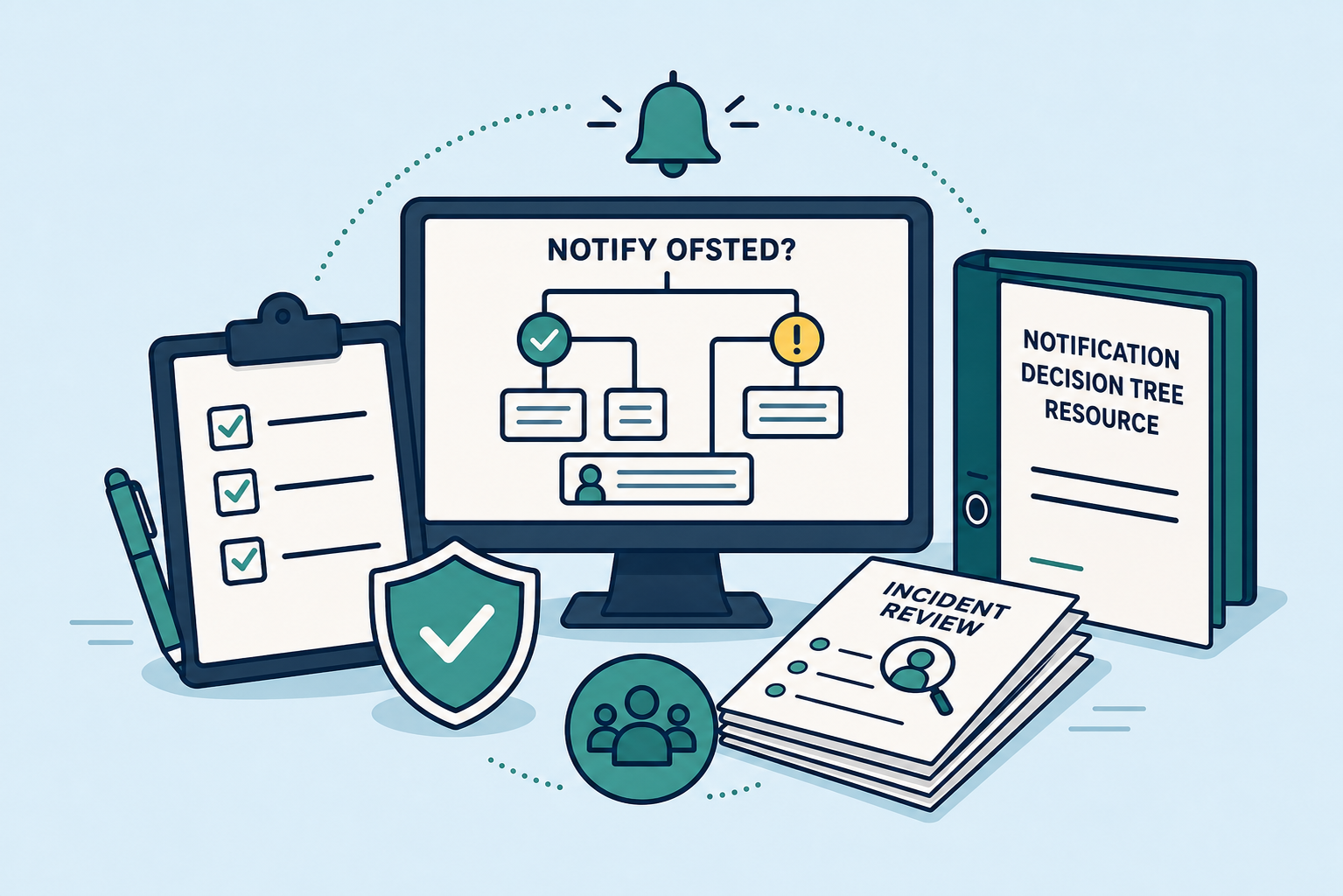
New Ofsted Notification Decision Tree Resources
To support Registered Persons and managers with these decisions, Social Care Skills has developed a new series of Notification Decision Tree resources.
The resources are available separately for:
- Regulation 40 Notification Decision Tree – Children’s Homes
- Regulation 27 Notification Decision Tree – Supported Accommodation
- Serious Incident Notification Decision Tree – Independent Fostering Agencies
Each decision tree follows the relevant regulatory framework and Ofsted’s serious incident reporting guidance.
The resources provide a clear visual route through the main notification categories and include practical prompts around police involvement, seriousness, patterns of incidents, escalation and cumulative impact.
They are designed as professional practice resources to support decision-making and do not replace the Regulations, Ofsted guidance or the professional judgement of the Registered Person.
The decision trees are available through the Social Care Skills Resources Centre.
Develop Your Understanding Further
Making notification decisions confidently requires more than knowing the list of events within a regulation.
Managers and senior leaders need to understand the regulatory thresholds, recognise when professional judgement is required and be able to clearly evaluate the seriousness and wider significance of an incident.
The next Social Care Skills live online Notifications of Serious Events seminar takes place on 11 August 2026.
The session explores notification requirements, regulatory thresholds and the professional judgement involved in deciding whether an incident should be notified to Ofsted.
Using practical examples and incident scenarios, participants will explore common areas of uncertainty, including police involvement, self-harm, missing episodes, safeguarding concerns and other serious incidents.
The seminar is particularly relevant to Registered Managers, Registered Service Managers, Responsible Individuals, Nominated Individuals and senior leaders working across children’s social care.
Training and Consultancy Support
Social Care Skills also provides bespoke training and consultancy support to children’s homes, supported accommodation providers and fostering services.
Our work includes incident review, notification decision-making, compliance audits, inspection readiness, policy and practice development and leadership support.
Where providers are experiencing repeated uncertainty around notifications, the issue is not always a lack of knowledge of the Regulations. Sometimes the wider challenge is management oversight, incident evaluation, recording, escalation and evidence of learning.
We can work with providers to review existing systems and develop clearer, more consistent approaches to incident management and regulatory decision-making.
For training, consultancy or support, contact Social Care Skills on 0330 043 0686 or explore our website.
Leave a Reply